
300 Mangos & Resilience Under Pressure
Try This Mindset Exercise!
As a leader, you will be tested over and over.
Something will go wrong. A failure will happen. And when that moment comes, your whole team will be looking to you to gauge how to respond.
Talk about being under pressure!
As the leader, you have huge influence over your team. If you react angrily, your team will feel your frustration. If you react patiently, your team likely will too.
Your reaction sets the tone for how everyone else will react. Which is why you need to cultivate an underrated leadership quality: resiliency.
A Mindset of Resiliency: Developing This Key Leadership Quality
As much as I love working with and coaching leaders, no amount of coaching can make leadership “easy.” Your journey of life and leadership will not be all sunshine and roses.
The word resilience comes from a Latin word that means “to jump back” or “to recoil.” It’s not a measure of how strong or tough you are. It’s a measure of how quickly you can “jump back” after a challenge or difficulty.
Being resilient means letting go of perfection. It requires a level of acceptance—that you will fall down, but how fast you get back up is more important than obsessing over the mistake.
Being resilient means relinquishing control. You can’t plan for every contingency, and even if you could, you can’t expect everything to unfold exactly according to your plans.
Being resilient means you can look ahead, not staying stuck in the past. When something does go wrong, you can gather your team and set your sights on a new goal. You learn from past mistakes, but are able to move on.
A Step Further: Finding the Gift
One of the best ways to develop a more resilient mindset is to pivot your mindset from, “This is a BAD situation” to “What good might come of this?”
This shift in focus literally changes the part of your brain that’s working on the problem and helps activate gratitude instead of frustration or disappointment.
A few weeks ago, I faced an opportunity to put this mindset shift into practice.
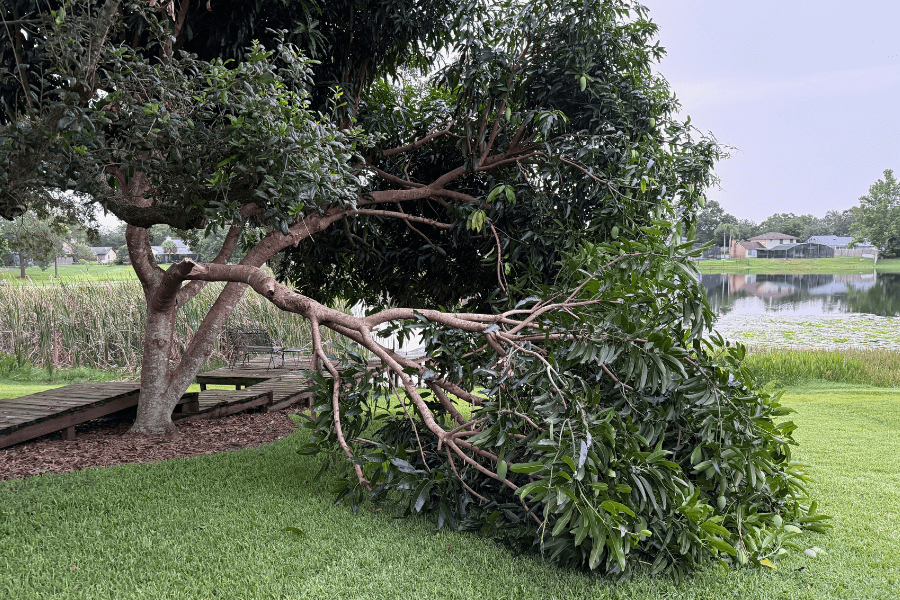
That morning, I woke early to find that a limb on my prized mango tree had cracked overnight. It had been weighed down by this year’s massive mango crop. I set about gathering the fallen mangos and filled two large laundry baskets with roughly 300 mangos.
I was sad because we weren’t quite ready to harvest. The mangos would typically get more time to mature on the tree. Maybe some would still ripen and be delicious, but the majority would probably never fully ripen.
With frustration rising and sweat building on my brow, I asked myself the question that’s integral to my resilient mindset: “What might be the gift?”
Here’s what I came up with in the moment:
- There were no humans or pets under the tree when it came down.
- It happened now, when some of the fruit might be mature enough to ripen, and not weeks ago when it definitely would not ripen.
- We were leaving in about 10 days for vacation, and it could have happened while we were gone.
- I had a crew coming the next day to trim bushes, so I could have them cut up and haul away the fallen branch.
Focusing my attention on this question and the answers helped me manage my irritation as I worked. By the time I showered and got into my workday, I had come to terms with this new reality. And for a large part, that’s what resiliency is—coming to terms with reality instead of fighting against it.
Had I not asked this question and shifted my mindset, the frustration would have followed me into my day. I might have snapped at my husband and been irritable with anyone I interacted with. Instead, I was focused on gratitude and not disappointment. My circumstances didn’t change…but my attitude did.
Putting It Into Practice
Take a sticky note and write that simple question on it: What might be the gift? Put it on your desk, in the kitchen, anywhere you will see it often.
Next time something doesn’t go as planned (which probably won’t be far off!) ask yourself this question. Try to find at least two gifts or ‘silver linings’ in the situation and write them down. Notice how this simple exercise helps you shift into a mindset of gratitude.
“You can’t control what happens to you, but you can control how you respond to it.” ~ John C. Maxwell
A resilient mindset is contagious, which is especially important for leaders. When you are able to find the best in a difficult situation, your team will take notice! As you grow in resilience, you will become a leader they can look up to more and more.
P.S. Stay tuned next week to hear about the totally unexpected gifts that developed from this mango tree tragedy!